Cochlear Implants and Learning Music Again
Enjoying music with a cochlear implant
Interdisciplinary Southampton team helps cochlear implant users to appreciate music.
Music is ubiquitous in all cultures and plays an important role in people's wellbeing and quality of life. At Southampton, researchers are helping those with severe to profound hearing loss to perceive music through their cochlear implant using an online tool.
Music is all around us; it's a central office of the globe," says Dr Ben Oliver, Associate Professor in Composition, at the University. "Whether you're at a wedding, funeral, listening to birdsong, or even in a lift, yous hear music," he adds.
Cochlear implant limitations
While cochlear implants (CI) can help those with severe to profound hearing loss to perceive speech, many CI users are unable to enjoy music through their implant. "This because the devices don't convey pitch information very well," says Dr Rachel van Besouw, former Lecturer and now Visiting Enquiry Fellow in the Institute of Sound and Vibration Research at Southampton.
Rachel explains that a cochlear implant has an array of small electrodes that are inserted into different regions of the cochlea (part of the inner ear) to requite pitch information. "Up to 22 electrodes are doing the chore of thousands of hair cells that would normally exist in the cochlea, so frequency resolution is poor. Pitch and the ability to recognise the timbre of sounds is compromised," says Rachel. "Being able to recognise voices and instruments is a big limitation of the device."
The case is also unlike for CI users who were able to hear in the past. "They may recollect what pieces of music used to audio similar. With a CI, the same pieces of music will probable sound dissimilar and perhaps even quite horrible, which tin can lead to a sense of loss," says Ben.
Joining forces
The interdisciplinary team from beyond the University joined forces to create 'Compositions for Cochlear Implantees', an initiative to aid CI users to appreciate music again. The team includes hearing scientists and audiologists, musicians, a composer and music therapist from the University's Found of Sound and Vibration Research, Auditory Implant Service and Music department. They work with external bodies such as the National Cochlear Implant User Association and the Ear Foundation. Major music artists such as Cliff Richard, Philip Selway from Radiohead and 10cc have donated songs to the initiative.
Rachel, Ben and the squad consulted with CI users about the development of a music rehabilitation resource to find out what people would detect useful.
Interactive experience
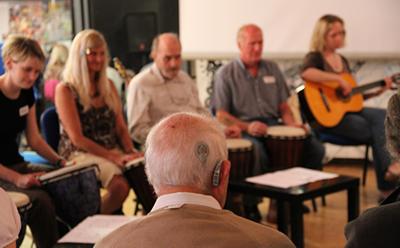
The workshops informed the composition of 7 original musical works by Ben for CI users, which were performed by an ensemble of professional and outstanding student musicians at a special concert in 2012. "The seven pieces of music were bespoke for CI users; instruments such as the harp were used due to the crisp beginning of notes and a lot of the sounds were short, rather than sustained notes," explains Ben. "The compositions worked in tandem with visual cues such as video and live audience participation, in guild to help users stay engaged and keep time with the music."
The new insights from the workshops and concert were also used to guide the development of a estimator-based music rehabilitation program called the Interactive Music Awareness Program (IMAP). The aim of this digital toolkit of interactive software is to assistance CI users to distinguish, recognise and appreciate different musical sounds. "The programme includes exercises where a CI user could alter the levels of different instruments in a piece of music to larn the private sounds of instruments over again," says Ben.
Online toolkit
The researchers then adult the IMAP into a free online platform, which all CI users can benefit from. Richard Polfreman, Acquaintance Professor of Music and practiced on the interface betwixt music and technology, redesigned the IMAP software, enhancing some of the features and so that information technology could be a downloadable system. "Users tin now become to www.morefrommusic.org, download software and bear out exercises on a regular basis so that they can retrain themselves to understand and start enjoying the music," says Richard.
"We now have over 250 CI users and near 200 professionals who have registered to use the IMAP resources, and the exercises are also used in workshops in the Auditory Implant Service," says Ben.
In 2018, equally part of the Option-cochlear implant home care project, funded by the Health Foundation, collaborators from the Auditory Implant Service, Music and Electronics and Computer science at the University developed the mixer app from the IMAP software into an hands accessible web app.
'More From Music for Choice' at present besides includes a mode for people to salvage their favourite music mixes and the team is hoping to add more tracks in the time to come. As technology has evolved, it has become possible to change IMAP into a web-based application, which was non feasible even just a few years ago.
"Fundamentally this project is virtually the importance of music, the perception of music by CI users, and how quality of life tin be increased by learning to savour music again," says Richard. "We are using music to benefit others in a straight way – helping people who have lost something from their lives to go that dorsum – it'due south very rewarding work," he adds.
mitchellhatomentand67.blogspot.com
Source: https://www.southampton.ac.uk/news/2016/04/enjoying-music-with-a-cochlear-implant.page

Post a Comment for "Cochlear Implants and Learning Music Again"