A Popular History of the Art of Music 1894 Mathews
English art is the torso of visual arts made in England. England has Europe'south earliest and northernmost ice-age cave art.[1] Prehistoric art in England largely corresponds with art made elsewhere in contemporary Britain, but early medieval Anglo-Saxon art saw the evolution of a distinctly English language fashion,[2] and English art continued thereafter to take a distinct grapheme. English art made after the germination in 1707 of the Kingdom of Uk may be regarded in most respects simultaneously as art of the Great britain.
Medieval English painting, mainly religious, had a strong national tradition and was influential in Europe.[iii] The English Reformation, which was chauvinistic to art, non merely brought this tradition to an abrupt stop but resulted in the devastation of about all wall-paintings.[4] [5] Only illuminated manuscripts now survive in skillful numbers.[6]
There is in the fine art of the English language Renaissance a strong interest in portraiture, and the portrait miniature was more than popular in England than anywhere else.[7] English Renaissance sculpture was mainly architectural and for awe-inspiring tombs.[8] Interest in English language mural painting had begun to develop past the time of the 1707 Human activity of Union.[9]
Substantive definitions of English art have been attempted by, amidst others, art scholar Nikolaus Pevsner (in his 1956 volume The Englishness of English language Art),[10] fine art historian Roy Strong (in his 2000 book The Spirit of Britain: A narrative history of the arts)[xi] and critic Peter Ackroyd (in his 2002 book Albion).[12]
Earliest art [edit]
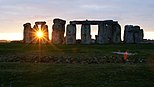
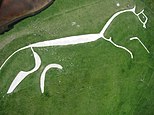
The earliest English art - also Europe's earliest and northernmost cave fine art - is located at Creswell Crags in Derbyshire, estimated at betwixt 13,000 and 15,000 years onetime.[13] In 2003, more than lxxx engravings and bas-reliefs, depicting deer, bison, horses, and what may be birds or bird-headed people were found there. The famous, big ritual mural of Stonehenge dates from the Neolithic menses; around 2600 BC.[14] From around 2150 BC, the Beaker people learned how to make statuary, and used both tin and gold. They became skilled in metal refining and their works of art, placed in graves or sacrificial pits have survived.[fifteen] In the Iron Age, a new art fashion arrived equally Celtic civilization and spread across the British isles. Though metalwork, especially golden ornaments, was still of import, stone and most likely wood were as well used.[16] This way continued into the Roman period, beginning in the 1st century BC, and establish a renaissance in the Medieval period. The arrival of the Romans brought the Classical style of which many monuments have survived, peculiarly funerary monuments, statues and busts. They also brought glasswork and mosaics.[17] In the fourth century, a new element was introduced every bit the commencement Christian fine art was fabricated in Britain. Several mosaics with Christian symbols and pictures have been preserved.[xviii] England boasts some remarkable prehistoric hill figures; a famous example is the Uffington White Horse in Oxfordshire, which "for more than 3,000 years . . . has been jealously guarded every bit a masterpiece of minimalist fine art."[19]
Earliest art: gallery [edit]

Medieval art [edit]
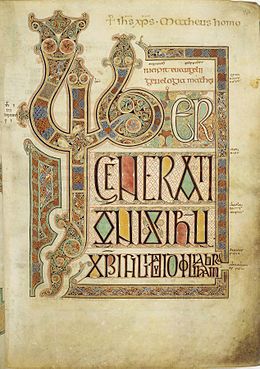
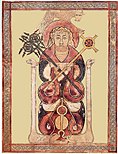
Afterwards Roman rule, Anglo-Saxon fine art brought the incorporation of Germanic traditions, as may be seen in the metalwork of Sutton Hoo.[25] Anglo-Saxon sculpture was outstanding for its time, at least in the small works in ivory or bone which are virtually all that survive.[26] Specially in Northumbria, the Insular art mode shared across the British Isles produced the finest work being produced in Europe, until the Viking raids and invasions largely suppressed the movement;[27] the Volume of Lindisfarne is i instance certainly produced in Northumbria.[28] Anglo-Saxon fine art adult a very sophisticated variation on contemporary Continental styles, seen specially in metalwork and illuminated manuscripts such equally the Benedictional of St. Æthelwold.[29] None of the large-scale Anglo-Saxon paintings and sculptures that we know existed have survived.[xxx]
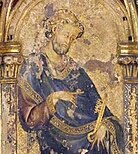
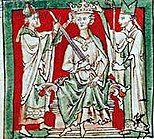
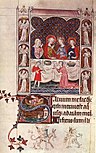
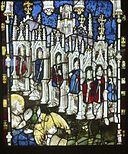
By the first half of the 11th century, English art benefited from lavish patronage by a wealthy Anglo-Saxon elite, who valued in a higher place all works in precious metals.[31] but the Norman Conquest in 1066 brought a sudden halt to this fine art nail, and instead works were melted down or removed to Normandy.[32] The and so-called Bayeux Tapestry - the big, English-made, embroidered cloth depicting events leading upwards to the Norman conquest - dates to the late 11th century.[33] Some decades afterwards the Norman conquest, manuscript painting in England was presently again amid the best of any in Europe; in Romanesque works such as the Winchester Bible and the St. Albans Psalter, then in early Gothic ones similar the Tickhill Psalter.[34] The best-known English language illuminator of the period is Matthew Paris (c. 1200–1259).[35] Some of the rare surviving examples of English medieval panel paintings, such every bit the Westminster Retable and Wilton Diptych, are of the highest quality.[36] From the late 14th century to the early 16th century, England had a considerable industry in Nottingham alabaster reliefs for mid-market altarpieces and small statues, which were exported across Northern Europe.[37] Another art form introduced through the church was stained glass, which was also adopted for secular uses.[38]
Medieval fine art: gallery [edit]






16th and 17th centuries [edit]
Nicholas Hilliard (c. 1547–7 January 1619) - "the first native-built-in genius of English painting"[54] - began a strong English tradition in the portrait miniature.[55] The tradition was continued by Hilliard'southward educatee Isaac Oliver (c. 1565–bur. 2 Oct 1617), whose French Huguenot parents had escaped to England in the creative person's childhood. Other notable English artists across the period include: Nathaniel Salary (1585–1627); John Bettes the Elder (agile c. 1531–1570) and John Bettes the Younger (died 1616); George Gower (c.1540–1596), William Larkin (early 1580s–1619), and Robert Peake the Elder (c. 1551–1619).[56] The artists of the Tudor court and their successors until the early 18th century included a number of influential imported talents: Hans Holbein the Younger, Anthony van Dyck, Peter Paul Rubens, Orazio Gentileschi and his daughter Artemisia, Sir Peter Lely (a naturalised English subject from 1662), and Sir Godfrey Kneller (a naturalised English subject by the time of his 1691 knighthood).[57]
The 17th century saw a number of significant English language painters of total-size portraits, near notably William Dobson 1611 (bapt. 1611-(bur. 1646); others include Cornelius Johnson (bapt. 1593–bur. 1661)[58] and Robert Walker (1599–1658). Samuel Cooper (1609-1672) was an accomplished miniaturist in Hilliard'due south tradition, equally was his brother Alexander Cooper (1609-1660), and their uncle, John Hoskins (1589/1590–1664). Other notable portraitists of the flow include: Thomas Flatman (1635-1688), Richard Gibson (1615-1690), the dissolute John Greenhill (c. 1644–1676), John Riley (1646-1691), and John Michael Wright (1617-1694). Francis Barlow (c. 1626 – 1704) is known as "the father of British sporting painting";[59] he was England's first wildlife painter, beginning a tradition that reached a loftier-point a century afterwards, in the work of George Stubbs (1724-1806).[60] English women began painting professionally in the 17th century; notable examples include Joan Carlile (c. 1606–79), and Mary Beale (née Cradock; 1633–1699).[61]
In the first half of the 17th century the English dignity became important collectors of European art, led by King Charles I and Thomas Howard, 21st Earl of Arundel.[62] By the end of the 17th century, the Grand Bout - a trip of Europe giving exposure to the cultural legacy of classical antiquity and the Renaissance - was de rigueur for wealthy young Englishmen.[63]
16th and 17th centuries: gallery [edit]


18th and 19th centuries [edit]
In the 18th century, English painting's distinct way and tradition continued to concentrate frequently on portraiture, merely interest in landscapes increased, and a new focus was placed on history painting, which was regarded as the highest of the hierarchy of genres,[79] and is exemplified in the extraordinary work of Sir James Thornhill (1675/1676–1734). History painter Robert Streater (1621–1679) was highly thought of in his time.[fourscore]
William Hogarth (1697–1764) reflected the burgeoning English eye-class temperament — English language in habits, disposition, and temperament, too as past birth. His satirical works, full of blackness sense of humor, point out to contemporary society the deformities, weaknesses and vices of London life. Hogarth'south influence can be establish in the distinctively English satirical tradition connected by James Gillray (1756–1815), and George Cruikshank (1792–1878).[81] One of the genres in which Hogarth worked was the conversation piece, a form in which sure of his contemporaries also excelled: Joseph Highmore (1692–1780), Francis Hayman (1708–1776), and Arthur Devis (1712–1787).[82]
Portraits were in England, every bit in Europe, the easiest and most profitable way for an artist to make a living, and the English tradition continued to evidence the relaxed elegance of the portrait-manner traceable to Van Dyck. The leading portraitists are: Thomas Gainsborough (1727–1788); Sir Joshua Reynolds (1723–1792), founder of the Imperial Academy of Arts; George Romney (1734–1802); Lemuel "Francis" Abbott (1760/61–1802); Richard Westall (1765–1836); Sir Thomas Lawrence (1769–1830); and Thomas Phillips (1770–1845). Also of annotation are Jonathan Richardson (1667–1745) and his student (and defiant son-in-law) Thomas Hudson (1701–1779). Joseph Wright of Derby (1734–1797) was well known for his candlelight pictures; George Stubbs (1724–1806) and, later, Edwin Henry Landseer (1802–1873) for their animal paintings. By the end of the century, the English swagger portrait was much admired abroad.[83]
London's William Blake (1757–1827) produced a diverse and visionary trunk of work defying straightforward classification; critic Jonathan Jones regards him as "far and away the greatest artist Uk has ever produced".[84] Blake's artist friends included neoclassicist John Flaxman (1755–1826), and Thomas Stothard (1755–1834) with whom Blake quarrelled.
In the popular imagination English landscape painting from the 18th century onwards typifies English language art, inspired largely from the love of the pastoral and mirroring as it does the evolution of larger country houses gear up in a pastoral rural landscape.[85] Two English Romantics are largely responsible for raising the status of mural painting worldwide: John Constable (1776–1837) and J. M. W. Turner (1775–1851), who is credited with elevating landscape painting to an eminence rivalling history painting.[86] [87] Other notable 18th and 19th century landscape painters include: George Arnald (1763–1841); John Linnell (1792–1882), a rival to Constable in his fourth dimension; George Morland (1763–1804), who developed on Francis Barlow'due south tradition of animal and rustic painting; Samuel Palmer (1805–1881); Paul Sandby (1731–1809), who is recognised as the begetter of English language watercolour painting;[88] and subsequent watercolourists John Robert Cozens (1752–1797), Turner'southward friend Thomas Girtin (1775–1802), and Thomas Heaphy (1775–1835).[89]
The early 19th century saw the emergence of the Norwich school of painters, the first provincial art movement exterior of London. Short-lived owing to thin patronage and internal dissent, its prominent members were "founding father" John Crome (1768–1821), John Sell Cotman (1782-1842), James Stark (1794–1859), and Joseph Stannard (1797–1830).[90]
The Pre-Raphaelite Brotherhood movement, established in the 1840s, dominated English language fine art in the second half of the 19th century. Its members — William Holman Hunt (1827–1910), Dante Gabriel Rossetti (1828–1882), John Everett Millais (1828–1896) and others — concentrated on religious, literary, and genre works executed in a colorful and minutely detailed, nigh photographic style.[91] Ford Madox Brown (1821–1893) shared the Pre-Raphaelites' principles.[92]
Leading English language art critic John Ruskin (1819–1900) was hugely influential in the latter half of the 19th century; from the 1850s he championed the Pre-Raphaelites, who were influenced past his ideas.[93] William Morris (1834–1896), founder of the Arts and crafts Movement, emphasised the value of traditional craft skills which seemed to be in reject in the mass industrial age. His designs, like the work of the Pre-Raphaelite painters with whom he was associated, referred oft to medieval motifs.[94] English narrative painter William Powell Frith (1819–1909) has been described every bit the "greatest British painter of the social scene since Hogarth",[95] and painter and sculptor George Frederic Watts (1817-1904) became famous for his symbolist work.
The gallant spirit of 19th century English language war machine fine art helped shape Victorian England's cocky-paradigm.[96] Notable English military artists include: John Edward Chapman 'Chester' Mathews (1843–1927);[97] Lady Butler (1846–1933);[98] Frank Dadd (1851–1929); Edward Matthew Unhurt (1852–1924); Charles Edwin Fripp (1854–1906);[99] Richard Caton Woodville, Jr. (1856–1927);[100] Harry Payne (1858–1927);[101] George Delville Rowlandson (1861–1930); and Edgar Alfred Holloway (1870–1941).[102] Thomas Davidson (1842–1919), who specialised in historical naval scenes,[103] incorporated remarkable reproductions of Nelson-related works by Arnald, Westall and Abbott in England'due south Pride and Celebrity (1894).[104]
To the end of the 19th century, the art of Aubrey Beardsley (1872–1898) contributed to the development of Art Nouveau, and suggested, among other things, an involvement in the visual art of Japan.[105]
18th and 19th centuries: gallery [edit]
-

-

-

-

-

-
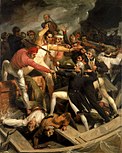
Richard Westall'southward Nelson in conflict with a Spanish launch, 3 July 1797; 1806.[120]
-

-

King George Iv depicted wearing coronation robes and four collars of chivalric orders: the Golden Fleece, Purple Guelphic, Bathroom and Garter by Thomas Lawrence; c. 1821
-

-

-

-

-

-

-

20th century [edit]
Impressionism found a focus in the New English language Art Order, founded in 1886.[135] Notable members included Walter Sickert (1860–1942) and Philip Wilson Steer (1860–1942), ii English painters with coterminous lives who became influential in the 20th century. Sickert went on to the post-impressionist Camden Boondocks Group, active 1911–1913, and was prominent in the transition to Modernism.[136] Steer'southward body of water and landscape paintings fabricated him a leading Impressionist, just subsequently piece of work displays a more traditional English style, influenced by both Constable and Turner.[137]
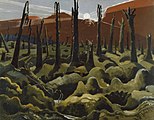
Paul Nash (1889–1946) played a fundamental part in the development of Modernism in English art. He was among the about of import mural artists of the first one-half of the twentieth century, and the artworks he produced during World War I are amongst the nigh iconic images of the conflict.[138] Nash attended the Slade School of Art, where the remarkable generation of artists who studied under the influential Henry Tonks (1862–1937) included, too, Harold Gilman (1876–1919), Spencer Gore (1878–1914), David Bomberg (1890–1957), Stanley Spencer (1891–1959), Mark Gertler (1891–1939), and Roger Hilton (1911–1975).
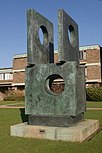
Modernism'south virtually controversial English talent was writer and painter Wyndham Lewis (1882–1957). He co-founded the Vorticist movement in fine art, and after condign improve known for his writing than his painting in the 1920s and early on 1930s he returned to more concentrated work on visual art, with paintings from the 1930s and 1940s constituting some of his best-known piece of work. Walter Sickert called Wyndham Lewis: "the greatest portraitist of this or whatever other time".[139] Modernist sculpture was exemplified by English artists Henry Moore (1898–1986), well known for his carved marble and larger-scale abstruse cast bronze sculptures, and Barbara Hepworth (1903–1975), who was a leading figure in the colony of artists who resided in St Ives, Cornwall during Earth War II.[140]
Lancastrian 50. S. Lowry (1887–1976) became famous for his scenes of life in the industrial districts of North Due west England in the mid-20th century. He adult a distinctive fashion of painting and is best known for his urban landscapes peopled with human figures ofttimes referred to equally "matchstick men".[141]
Notable English artists of the mid-20th century and later include: Graham Sutherland (1903–1980); Carel Weight (1908–1997); Ruskin Spear (1911–1990); pop fine art pioneers Richard Hamilton (1922–2011), Peter Blake (b. 1932), and David Hockney (b. 1937); and op fine art exemplar Bridget Riley (b. 1931).
Following the evolution of Postmodernism, English art became in some respect synonymous toward the finish of the 20th century with the Turner Prize; the prize, established in 1984 and named with ostensibly credible intentions later J. M. W. Turner, earned for latterday English language art a reputation arguably to its detriment.[142] Prize exhibits have included a shark in formaldehyde and a dishevelled bed.[143] Critic Matthew Collings observes that: "Turner Prize art is based on a formula where something looks startling at first and so turns out to be expressing some kind of banal thought, which somebody will be sure to tell you about. The ideas are never important or even really ideas, more than notions, like the notions in advert. Nobody pursues them anyway, because there'southward nil in that location to pursue."[144]
While the Turner Prize establishment satisfied itself with weak conceptual homages to authentic iconoclasts like Duchamp and Manzoni,[145] it spurned original talents such as Beryl Cook (1926–2008).[146] The accolade ceremony has since 2000 attracted annual demonstrations by the "Stuckists", a group calling for a return to figurative art and aesthetic authenticity. Observing wryly that "the only artist who wouldn't be in danger of winning the Turner Prize is Turner", the Stuckists staged in 2000 a "Real Turner Prize 2000" exhibition, promising (by contrast) "no rubbish".[147]
20th century: gallery [edit]
-

-

-
-

-

-

Ruskin Spear'southward Patients waiting Outside a Showtime Assist Mail in a Factory; 1942.[156]
-
21st century [edit]
The sculptor Antony Gormley (b. 1950) expressed doubts a decade later on winning the Turner Prize about his "usefulness to the human race",[161] and work including Another Place (2005) and Event Horizon (2012) has achieved both acclamation and popularity. The pseudo-subversive urban fine art of Banksy,[162] has been much discussed in the media.[163]
A highly visible and much praised work of public fine art, seen for a cursory period in 2014 was Blood Swept Lands and Seas of Red, a collaboration between artist Paul Cummins (b. 1977) and theatre designer Tom Piper. The installation at the Belfry of London between July and Nov 2014 commemorated the centenary of the outbreak of World War I; it consisted of 888,246 ceramic red poppies, each intended to correspond i British or Colonial serviceman killed in the State of war.[164]
Leading contemporary printmakers include Norman Ackroyd and Richard Spare.
English art on display [edit]
- British Museum
- Delaware Art Museum
- National Gallery
- National Portrait Gallery
- Tate U.k.
- Victoria and Albert Museum
- Walker Art Gallery
- Yale Center for British Art
Run into likewise [edit]
- Art of the United Kingdom
- Arts Council England
- British art
- English underground
- Insular art
- List of British painters
- Museums in England
- Neo-romanticism
- Royal Collection
- The Assay of Dazzler by William Hogarth (1753)
Farther reading [edit]
- David Bindman (ed.), The Thames and Hudson Encyclopaedia of British Art (London, 1985)
- Joseph Shush, English Art, 1714–1800 (Oxford, 1976)
- William Gaunt, A Curtailed History of English Painting (London, 1978)
- William Gaunt, The Great Century of British Painting: Hogarth to Turner (London, 1971)
- Nikolaus Pevsner, The Englishness of English language Art (London, 1956)
- William Vaughan, British Painting: The Golden Age from Hogarth to Turner (London, 1999)
- Ellis Waterhouse, Painting in U.k., 1530-1790, 4th Edn, 1978, Penguin Books (at present Yale History of Art series)
References [edit]
- ^ "Britain'south first nude?". The Daily Telegraph . Retrieved 28 Baronial 2017.
- ^ "Anglo-Saxon art". Encyclopædia Britannica . Retrieved 28 August 2017.
- ^ "Western Nighttime Ages And Medieval Christendom". Encyclopædia Britannica . Retrieved 28 August 2017.
- ^ "The story of the Reformation needs reforming". The Daily Telegraph. Archived from the original on 23 June 2012. Retrieved 11 September 2017.
- ^ "Art under Assault: Histories of British Iconoclasm". Tate. Retrieved 28 August 2017.
- ^ "Manuscripts from the 8th to the 15th century". British Library. Retrieved 28 August 2017.
- ^ "Portrait Painting in England, 1600–1800". Metropolitan Museum of Art. Retrieved 28 August 2017.
- ^ "Medieval And Renaissance Sculpture". Ashmolean Museum. Retrieved 28 August 2017.
- ^ "Edge of darkness". The Guardian . Retrieved 28 August 2017.
- ^ "Nikolaus Pevsner: The Englishness of English Art: 1955". BBC Online . Retrieved 30 August 2017.
- ^ "That was then..." The Guardian . Retrieved xxx August 2017.
- ^ "Ackroyd'due south England". The Daily Telegraph . Retrieved thirty Baronial 2017.
- ^ "Prehistory: Arts & Invention". English Heritage. Retrieved 28 Baronial 2017.
- ^ "World's oldest putter found on stone". The Daily Telegraph . Retrieved 28 August 2017.
- ^ "Why these Bronze Age relics make me bound for joy". The Daily Telegraph . Retrieved 28 August 2017.
- ^ "The Celts: non quite the barbarians history would have us believe". The Observer . Retrieved 28 August 2017.
- ^ "Romans: Arts & Invention". English Heritage. Retrieved 28 August 2017.
- ^ "Jesus, the early years". The Guardian . Retrieved 28 Baronial 2017.
- ^ "Big Brother's logo 'defiles' White Horse". The Observer . Retrieved 10 September 2017.
- ^ "Graffiti disfigured Ice Age cave art". The Daily Telegraph . Retrieved 11 September 2017.
- ^ "Stonehenge: not archæology, but art". The Guardian . Retrieved 11 September 2017.
- ^ "Uffington White Horse (c.1000BC)". The Independent . Retrieved 11 September 2017.
- ^ "Archaeologists and amateurs agree pact". The Guardian . Retrieved 11 September 2017.
- ^ "Sacred mysteries". The Daily Telegraph . Retrieved eleven September 2017.
- ^ "Anglo-Saxon treasure hoard casts Beowulf and wealthy warriors of Mercia in a new lite". The Guardian . Retrieved 28 August 2017.
- ^ "Ivory Carvings in England from Before the Norman Conquest". BBC History. Retrieved 28 August 2017.
- ^ "Insular Fine art". Oxford Bibliographies Online. Retrieved 28 August 2017.
- ^ "Everything is illuminated". The Guardian . Retrieved 28 August 2017.
- ^ "Benedictional of St Aethelwold". British Library. Retrieved 28 August 2017.
- ^ "Anglo-Saxon art from the 7th century to the Norman conquest". History Today . Retrieved 28 August 2017.
- ^ "Largest Anglo-Saxon hoard in history discovered". The Daily Telegraph . Retrieved 28 August 2017.
- ^ "The Norman Globe of Art". History Today . Retrieved 28 August 2017.
- ^ "Campaign to bring the Bayeux Tapestry back to Britain". The Daily Telegraph . Retrieved 28 Baronial 2017.
- ^ "Romanesque Fine art". Oxford Bibliographies Online. Retrieved 29 August 2017.
- ^ "Matthew Paris: English artist and historian". Encyclopædia Britannica . Retrieved 29 August 2017.
- ^ "'Rarest' medieval panel painting saved by recycling". The Daily Telegraph . Retrieved 29 August 2017.
- ^ "Alabaster Collection". Nottingham Castle. Archived from the original on 3 August 2017. Retrieved 29 August 2017.
- ^ "Object of the week: stained drinking glass". The Daily Telegraph . Retrieved 11 September 2017.
- ^ "Savage warrior: Sutton Hoo Helmet". The Guardian . Retrieved xi September 2017.
- ^ "Revealed: hidden art behind the gospel truth". The Guardian . Retrieved 11 September 2017.
- ^ "St Chad Gospels". Lichfield Cathedral. Retrieved xi September 2017.
- ^ "Towns and a tapestry". The Guardian . Retrieved 11 September 2017.
- ^ "Psalter returns to St Albans Cathedral". BBC News . Retrieved 11 September 2017.
- ^ "The Peterborough Psalter". Fitzwilliam Museum. Retrieved 11 September 2017.
- ^ "National Gallery unveils England's oldest altarpiece". The Guardian . Retrieved 11 September 2017.
- ^ "The Creation of the World, in the 'Flowers of History'". British Library. Retrieved eleven September 2017.
- ^ "Detailed tape for Regal 2 B VII". British Library. Retrieved xi September 2017.
- ^ "Luttrell Psalter". British Library. Retrieved 11 September 2017.
- ^ "'Virile, if Somewhat Irresponsible' Design: The Marginalia of the Gorleston Psalter". British Library. Retrieved 11 September 2017.
- ^ "Tickhill Psalter". University of Missouri. Retrieved xi September 2017.
- ^ "A precious stone set in a silvery bounding main: The Wilton Diptych: Andrew Graham-Dixon deciphers the royal message for so long curtained inside medieval England's nearly famous painting". The Independent . Retrieved 11 September 2017.
- ^ "Consecration of St Thomas Becket as archbishop". Victoria and Albert Museum. Retrieved 31 Baronial 2017.
- ^ "Midlands glazier created this medieval masterpiece". Birmingham Mail . Retrieved xi September 2017.
- ^ Wilson, Simon (1979). British Art. London: The Tate Gallery & The Bodley Head. p. 12. ISBN0370300343.
- ^ "Small is cute". The Daily Telegraph . Retrieved 12 September 2017.
- ^ Gaunt, William (1978). A Concise History of English language Painting. London: Thames & Hudson. pp. 15–56.
- ^ "Paintings". Royal Collection Trust. Retrieved 12 September 2017.
- ^ "Cornelius Johnson: Charles I's Forgotten Painter". National Portrait Gallery. Retrieved 29 August 2017.
- ^ Artworks by or after English art, Fine art UK. Retrieved 8 September 2016.
- ^ "Monkeys and Dogs Playing: Francis Barlow (1626–1704)". Art UK. Retrieved 8 September 2016.
- ^ Gaunt, William (1978). A Concise History of English language Painting. London: Thames & Hudson. pp. 29–56.
- ^ "Charles I art collection reunited for first fourth dimension in 350 years as Imperial Academy relocates works from Van Dyke and Titian". The Daily Telegraph . Retrieved 29 August 2017.
- ^ "The Boondocks & Country Grand Bout". Town and Country Mag. Retrieved 29 August 2017.
- ^ "Would the real Anne Boleyn please come up forward?". On the Tudor Trail. Retrieved one September 2017.
- ^ Montrose, Louis (2006). The Subject of Elizabeth: Authorization, Gender, and Representation. Chicago: University of Chicago Printing. p. 123. ISBN0226534758.
- ^ "Portraits of Queen Elizabeth The First, Office ii: Portraits 1573-1587". Luminarium: Album of English Literature. Retrieved 12 September 2017.
- ^ "'Fellow Among Roses' by Nicholas Hilliard (1547–1619)". Victoria and Albert Museum. Retrieved 29 August 2017.
- ^ "A Beau Seated Nether a Tree, c. 1590-1595". Purple Drove. Retrieved xi September 2017.
- ^ "The Final Years of Elizabeth I's Reign". History Today . Retrieved 12 September 2017.
- ^ "The only true painting of Shakespeare - probably". The Guardian . Retrieved 2 September 2017.
- ^ Wihl, Gary (1988). Literature and Ideals: Essays Presented to A. Due east. Malloch . Montreal, Quebec: McGill-Queen's University Press. p. 37. ISBN0773506624.
- ^ "William Dobson: Charles II, 1630 - 1685. King of Scots 1649 - 1685. King of England and Ireland 1660 - 1685 (When Prince of Wales, with a page)". Scottish National Portrait Gallery. Retrieved 12 September 2017.
- ^ "Male monarch Charles I at his Trial". National trust. Retrieved 11 September 2017.
- ^ "John Evelyn". National Portrait Gallery, London. Retrieved eleven September 2017.
- ^ "Charles II (1630-1685) c.1676". Majestic Collection Trust. Retrieved 12 September 2017.
- ^ "John Locke". National Portrait Gallery, London. Retrieved 12 September 2017.
- ^ Hodnett, Edward (1978). Francis Barlow: The Outset Master of English language Volume Illustration. London: Scolar Press. p. 106. ISBN0859673502.
- ^ "Creative person: John Riley, British, 1646-1691; Samuel Pepys". Yale Academy Art Gallery. Retrieved 12 September 2017.
- ^ "Painting history: Manet on a mission". The Daily Telegraph . Retrieved 29 August 2017.
- ^ "Sheldonian ceiling restored". The Guardian . Retrieved 29 Baronial 2017.
- ^ "Hogarth, the father of the modernistic drawing". The Daily Telegraph . Retrieved 29 August 2017.
- ^ Newman, Gerald (1978). Britain in the Hanoverian Age, 1714-1837. London: Routledge. p. 525. ISBN0815303963.
- ^ "A Short History of British Portraiture". Purple Society of Portrait Painters. Retrieved 29 August 2017.
- ^ "Blake's heaven". The Guardian . Retrieved 31 August 2017.
- ^ "Constable, Turner, Gainsborough and the Making of Landscape". The Guardian . Retrieved xxx Baronial 2017.
- ^ Lacayo, Richard (11 Oct 2007). "The Sunshine Boy". Time. Archived from the original on October 12, 2007.
At the turn of the 18th century, history painting was the highest purpose fine art could serve, and Turner would try those heights all his life. Simply his existent accomplishment would be to make landscape the equal of history painting.
- ^ "British Watercolours 1750-1900: The Landscape Genre". Encyclopædia Britannica . Retrieved 29 August 2017.
- ^ "Paul Sandby at Royal Academy". The Daily Telegraph . Retrieved 29 August 2017.
- ^ "Landscape painting". Victoria and Albert Museum. Retrieved 29 August 2017.
- ^ "Made In England: Norfolk". BBC Online . Retrieved 29 August 2017.
- ^ "Pre-Raphaelite art: the paintings that obsessed the Victorians". The Daily Telegraph . Retrieved 29 August 2017.
- ^ "Into the Frame: the 4 Loves of Ford Madox Dark-brown by Angela Thirlwell: review". The Daily Telegraph . Retrieved 29 Baronial 2017.
- ^ "John Ruskin'southward marriage: what really happened". The Guardian . Retrieved 31 August 2017.
- ^ "Who was William Morris? The textile designer and early socialist whose legacy is still felt today". The Daily Telegraph . Retrieved 31 August 2017.
- ^ "William Powell Frith, 1819–1909". Tate. Retrieved 11 September 2017.
- ^ "Artist and Empire review – a captivating look at the colonial times we withal live in". The Guardian . Retrieved 31 August 2017.
- ^ "The Accuse of the 21st Lancers at Omdurman, 2 September 1898". National Ground forces Museum. Retrieved 31 August 2017.
- ^ "Tate Britain to explore - merely not celebrate - art and the British Empire". The Daily Telegraph . Retrieved 31 August 2017.
- ^ "The Battle of Isandlwana, 22 January 1879". National Army Museum. Retrieved 31 August 2017.
- ^ "The Accuse of the Light Brigade, 1854". National Army Museum. Retrieved 31 August 2017.
- ^ "Harry Payne: Artist". Look and Larn. Retrieved 31 August 2017.
- ^ "Edgar Alfred Holloway - 1870-1941". Canadian Anglo-Boer State of war Museum. Retrieved 31 Baronial 2017.
- ^ "Nelson's Last Signal at Trafalgar". National Maritime Museum. Retrieved 12 September 2017.
- ^ "England's Pride and Glory". National Maritime Museum. Retrieved 12 September 2017.
- ^ "Erotic bliss shared past all at Shunga: Sexual activity and Pleasure in Japanese Fine art". The Guardian . Retrieved 30 Baronial 2017.
- ^ "History of the Painted Hall". Old Regal Naval College. Retrieved 1 September 2017.
- ^ "Alexander Pope". Museum of Fine Arts, Boston. Retrieved 1 September 2017.
- ^ "Marriage A-la-Manner: 2, The Tête à Tête". National Gallery. Retrieved 1 September 2017.
- ^ "General James Wolfe (1727-1759) every bit a Young Man". National Trust-Quebec House. Retrieved 1 September 2017.
- ^ "Mr and Mrs Andrews". National Gallery. Retrieved 1 September 2017.
- ^ "Swell Works: The James Family (1751) by Arthur Devis". The Independent . Retrieved ane September 2017.
- ^ "Robert Clive and Mir Jafar after the Battle of Plassey, 1757". National Portrait Gallery, London. Retrieved 1 September 2017.
- ^ "Stubbs's equine masterpiece puts animal passion into the National". The Independent . Retrieved 11 September 2017.
- ^ "Warren Hastings". National Portrait Gallery, London. Retrieved 1 September 2017.
- ^ "An Experiment on a Bird in the Air Pump". National Gallery. Retrieved 2 September 2017.
- ^ "Emma Hamilton and George Romney". Walker Art Gallery. Retrieved 1 September 2017.
- ^ "Horatio Nelson". National Portrait Gallery, London. Retrieved i September 2017.
- ^ "Europe: a Prophecy". British Museum. Retrieved xi September 2017.
- ^ "Henry John Temple, 3rd Viscount Palmerston". National Portrait Gallery, London. Retrieved 11 September 2017.
- ^ "Nelson in conflict with a Spanish launch, 3 July 1797". National Maritime Museum. Retrieved 12 September 2017.
- ^ "The Pilgrimage to Canterbury, 1806–7". Tate. Retrieved 11 September 2017.
- ^ "The Plumb-pudding in danger - or - Land Epicures taking un Petit Souper by Gillray". British Library. Retrieved 2 September 2017.
- ^ "Saluting the R-ts bomb uncovered on his nascency mean solar day August 12th. 1816". British Museum. Retrieved 2 September 2017.
- ^ "Portrait of Knuckles of Wellington". Waterloo 200. Retrieved ii September 2017.
- ^ "The Destruction of 'Fifty'Orient' at the Battle of the Nile, 1 Baronial 1798". National Maritime Museum. Retrieved 12 September 2017.
- ^ "Portrait of Lord Byron in Albanian Wearing apparel". British Library. Retrieved ane September 2017.
- ^ "The Fighting Temeraire". National Gallery. Retrieved 1 September 2017.
- ^ "Our English Coasts, 1852 ('Strayed Sheep') 1852". Tate. Retrieved 10 September 2017.
- ^ "Oil Painting - The Concluding of England". Birmingham Museum and Art Gallery. Retrieved two September 2017.
- ^ "Charles Dickens". Victoria and Albert Museum. Retrieved eleven September 2017.
- ^ "What to say about... John Ruskin". The Guardian . Retrieved 2 September 2017.
- ^ "Charles George Gordon". National Portrait Gallery, London. Retrieved two September 2017.
- ^ "England's Pride and Glory". Art UK. Retrieved 13 September 2017.
- ^ "The Charge of the 21st Lancers at the Boxing of Omdurman, 1898". National Ground forces Museum. Retrieved 11 September 2017.
- ^ "New English Art Order". Tate. Retrieved 1 September 2017.
- ^ "Walter Richard Sickert: British artist". Encyclopædia Britannica . Retrieved i September 2017.
- ^ "Philip Wilson Steer: British creative person". Encyclopædia Britannica . Retrieved ane September 2017.
- ^ "The Archival Trail: Paul Nash the war artist". Tate. Retrieved one September 2017.
- ^ "Wyndham Lewis: a monster - and a master of portrait painting". The Daily Telegraph . Retrieved one September 2017.
- ^ "Why it'south time you fell in love with Britain'southward battered post-war statues". The Daily Telegraph . Retrieved ane September 2017.
- ^ "LS Lowry at Tate Britain: glimpses of a world beyond". The Guardian . Retrieved 1 September 2017.
- ^ "Non all modern art is trivial buffoonery". The Daily Telegraph . Retrieved 1 September 2017.
- ^ "He'due south our favourite artist. And so why do the galleries hate him so much?". The Guardian . Retrieved 1 September 2017.
- ^ "Blake's progress". The Observer . Retrieved 1 September 2017.
- ^ "Fine art in 2015: forget the Turner prize - this was the year the Sometime Masters became sexy". The Daily Telegraph . Retrieved 10 September 2017.
- ^ "Beryl Cook". The Daily Telegraph . Retrieved 10 September 2017.
- ^ "Stuck on the Turner Prize". Artnet. Retrieved 12 September 2017.
- ^ "Girls Running, Walberswick Pier; 1888–94". Tate. Retrieved i September 2017.
- ^ "Spencer GoreInez and Taki; 1910". Tate. Retrieved 12 September 2017.
- ^ "Harold Gilman: Leeds Marketplace, c.1913". Tate. Retrieved 12 September 2017.
- ^ "Brighton Pierrots; 1915". Tate. Retrieved 1 September 2017.
- ^ "Mark Gertler: Merry-Go-Round, 1916". Tate. Retrieved xiii September 2017.
- ^ "We are Making a New World". Imperial War Museum. Retrieved 1 September 2017.
- ^ "Sappers at Work: Canadian Tunnelling Company, R14, St Eloi". Imperial War Museum. Retrieved 11 September 2017.
- ^ "A Battery Shelled". Imperial War Museum. Retrieved 1 September 2017.
- ^ "Patients waiting outside a beginning assist post in a manufactory". Canadian War Museum. Retrieved 1 September 2017.
- ^ "Recruit's progress: medical inspection". Canadian War Museum. Retrieved 1 September 2017.
- ^ "Shipbuilding on the Clyde: The Furnaces". Imperial War Museum. Retrieved 11 September 2017.
- ^ "'World's largest tapestry' at Coventry Cathedral repaired". BBC News . Retrieved ane September 2017.
- ^ "4-Square (Walk Through), 1966". Tate. Retrieved 12 September 2017.
- ^ "The legacy game: Gormley isn't the beginning creative person to worry about his identify in history". The Guardian . Retrieved 12 September 2017.
- ^ "Supposing ... Subversive genius Banksy is actually rubbish". The Guardian . Retrieved 11 September 2017.
- ^ "Britain'south all-time-loved artwork is a Banksy. That's proof of our stupidity". The Guardian . Retrieved eleven September 2017.
- ^ "Blood-swept lands: the story backside the Tower of London poppies tribute". The Guardian . Retrieved one September 2017.
mitchellhatomentand67.blogspot.com
Source: https://en.wikipedia.org/wiki/English_art

Post a Comment for "A Popular History of the Art of Music 1894 Mathews"